Original: $16.96
-65%$16.96
$5.94The Story
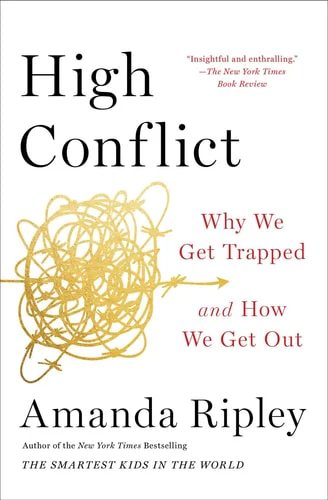
When we are baffled by the insanity of the “other
side”—in our politics, at work, or at home—it’s because we aren’t seeing how
the conflict itself has taken over.
That’s what “high conflict” does. It’s the invisible hand of our time. And it’s
different from the useful friction of healthy conflict. That’s good conflict,
and it’s a necessary force that pushes us to be better people.
High conflict is what happens when discord distills into a good-versus-evil
kind of feud, the kind with an us and a them. In
this state, the brain behaves differently. We feel increasingly certain of our
own superiority, and everything we do to try to end the conflict, usually makes
it worse. Eventually, we can start to mimic the behavior of our adversaries,
harming what we hold most dear.
In this “compulsively readable” (Evan Osnos, National Book Award-winning
author) book, New York Times bestselling author and
award-winning journalist Amanda Ripley investigates how good people get
captured by high conflict—and how they break free.
Our journey begins in California, where a world-renowned conflict expert
struggles to extract himself from a political feud. Then we meet a Chicago gang
leader who dedicates his life to a vendetta—only to realize, years later, that
the story he’d told himself about the conflict was not quite true. Next, we
travel to Colombia, to find out whether thousands of people can be nudged out
of high conflict at scale. Finally, we return to America to see what happens
when a group of liberal Manhattan Jews and conservative Michigan corrections
officers choose to stay in each other’s homes in order to understand one another
better, even as they continue to disagree.
All these people, in dramatically different situations, were drawn into high
conflict by similar forces, including conflict entrepreneurs, humiliation, and
false binaries. But ultimately, all of them found ways to transform high
conflict into good conflict, the kind that made them better people. They
rehumanized and recategorized their opponents, and they revived curiosity and
wonder, even as they continued to fight for what they knew was
right.
People do escape high conflict. Individuals—even entire
communities—can short-circuit the feedback loops of outrage and blame, if they
want to. This is an “insightful and enthralling” (The New York Times Book
Review) book—and a mind-opening new way to think about conflict that
will transform how we move through the world.
About the Author
Amanda Ripley is the New York Times bestselling author of The Smartest Kids in the World, High Conflict, and The Unthinkable.
She writes for The Atlantic, Politico, The Washington Post, The New York Times, and The Wall Street Journal, among other publications.
Description
When we are baffled by the insanity of the “other
side”—in our politics, at work, or at home—it’s because we aren’t seeing how
the conflict itself has taken over.
That’s what “high conflict” does. It’s the invisible hand of our time. And it’s
different from the useful friction of healthy conflict. That’s good conflict,
and it’s a necessary force that pushes us to be better people.
High conflict is what happens when discord distills into a good-versus-evil
kind of feud, the kind with an us and a them. In
this state, the brain behaves differently. We feel increasingly certain of our
own superiority, and everything we do to try to end the conflict, usually makes
it worse. Eventually, we can start to mimic the behavior of our adversaries,
harming what we hold most dear.
In this “compulsively readable” (Evan Osnos, National Book Award-winning
author) book, New York Times bestselling author and
award-winning journalist Amanda Ripley investigates how good people get
captured by high conflict—and how they break free.
Our journey begins in California, where a world-renowned conflict expert
struggles to extract himself from a political feud. Then we meet a Chicago gang
leader who dedicates his life to a vendetta—only to realize, years later, that
the story he’d told himself about the conflict was not quite true. Next, we
travel to Colombia, to find out whether thousands of people can be nudged out
of high conflict at scale. Finally, we return to America to see what happens
when a group of liberal Manhattan Jews and conservative Michigan corrections
officers choose to stay in each other’s homes in order to understand one another
better, even as they continue to disagree.
All these people, in dramatically different situations, were drawn into high
conflict by similar forces, including conflict entrepreneurs, humiliation, and
false binaries. But ultimately, all of them found ways to transform high
conflict into good conflict, the kind that made them better people. They
rehumanized and recategorized their opponents, and they revived curiosity and
wonder, even as they continued to fight for what they knew was
right.
People do escape high conflict. Individuals—even entire
communities—can short-circuit the feedback loops of outrage and blame, if they
want to. This is an “insightful and enthralling” (The New York Times Book
Review) book—and a mind-opening new way to think about conflict that
will transform how we move through the world.
About the Author
Amanda Ripley is the New York Times bestselling author of The Smartest Kids in the World, High Conflict, and The Unthinkable.
She writes for The Atlantic, Politico, The Washington Post, The New York Times, and The Wall Street Journal, among other publications.