The Story
‘The Master said, “If a man sets his heart on
benevolence, he will be free from evil”’
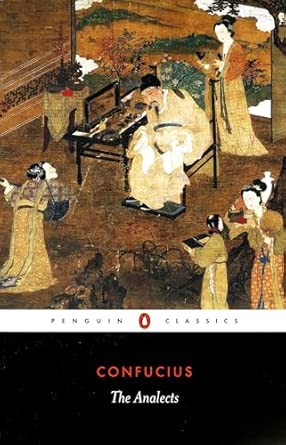
The Analects are a collection of Confucius’s sayings brought
together by his pupils shortly after his death in 497 BC. Together they express
a philosophy, or a moral code, by which Confucius, one of the most humane
thinkers of all time, believed everyone should live. Upholding the ideals of
wisdom, self-knowledge, courage and love of one’s fellow man, he argued that
the pursuit of virtue should be every individual’s supreme goal. And, while
following the Way, or the truth, might not result in immediate or material gain,
Confucius showed that it could nevertheless bring its own powerful and lasting
spiritual rewards.
This edition contains a detailed introduction exploring the concepts of the
original work, a bibliography and glossary and appendices on Confucius
himself, The Analects and the disciples who compiled them.
For more than seventy years, Penguin has been the leading publisher of classic
literature in the English-speaking world. With more than 1,700 titles,
Penguin Classics represents a global bookshelf of the best works throughout
history and across genres and disciplines. Readers trust the series to
provide authoritative texts enhanced by introductions and notes by
distinguished scholars and contemporary authors, as well as
up-to-date translations by award-winning translators.
About the Author
Confucius (551-479 BC), though of noble descent,
was born in humble circumstances. He believed that politics is only an
extension of morals, and spent ten years travelling through the various states
of China spreading his ideas. When he realised that there was no way of
converting the feudal rulers to his way of thinking he returned to Lu and spent
the rest of his life there teaching his pupils.
D.C. Lau read Chinese at the University of Hong Kong, and, in 1946,
he went to Glasgow, where he read philosophy. In 1950 he entered the School of
Oriental and African Studies in London to teach Chinese philosophy. After
lecturing in Chinese philosophy at the University of London he returned to Hong
Kong, where he is a Professor at the Chinese University.
Description
‘The Master said, “If a man sets his heart on
benevolence, he will be free from evil”’
The Analects are a collection of Confucius’s sayings brought
together by his pupils shortly after his death in 497 BC. Together they express
a philosophy, or a moral code, by which Confucius, one of the most humane
thinkers of all time, believed everyone should live. Upholding the ideals of
wisdom, self-knowledge, courage and love of one’s fellow man, he argued that
the pursuit of virtue should be every individual’s supreme goal. And, while
following the Way, or the truth, might not result in immediate or material gain,
Confucius showed that it could nevertheless bring its own powerful and lasting
spiritual rewards.
This edition contains a detailed introduction exploring the concepts of the
original work, a bibliography and glossary and appendices on Confucius
himself, The Analects and the disciples who compiled them.
For more than seventy years, Penguin has been the leading publisher of classic
literature in the English-speaking world. With more than 1,700 titles,
Penguin Classics represents a global bookshelf of the best works throughout
history and across genres and disciplines. Readers trust the series to
provide authoritative texts enhanced by introductions and notes by
distinguished scholars and contemporary authors, as well as
up-to-date translations by award-winning translators.
About the Author
Confucius (551-479 BC), though of noble descent,
was born in humble circumstances. He believed that politics is only an
extension of morals, and spent ten years travelling through the various states
of China spreading his ideas. When he realised that there was no way of
converting the feudal rulers to his way of thinking he returned to Lu and spent
the rest of his life there teaching his pupils.
D.C. Lau read Chinese at the University of Hong Kong, and, in 1946,
he went to Glasgow, where he read philosophy. In 1950 he entered the School of
Oriental and African Studies in London to teach Chinese philosophy. After
lecturing in Chinese philosophy at the University of London he returned to Hong
Kong, where he is a Professor at the Chinese University.