Original: $31.68
-65%$31.68
$11.09The Story
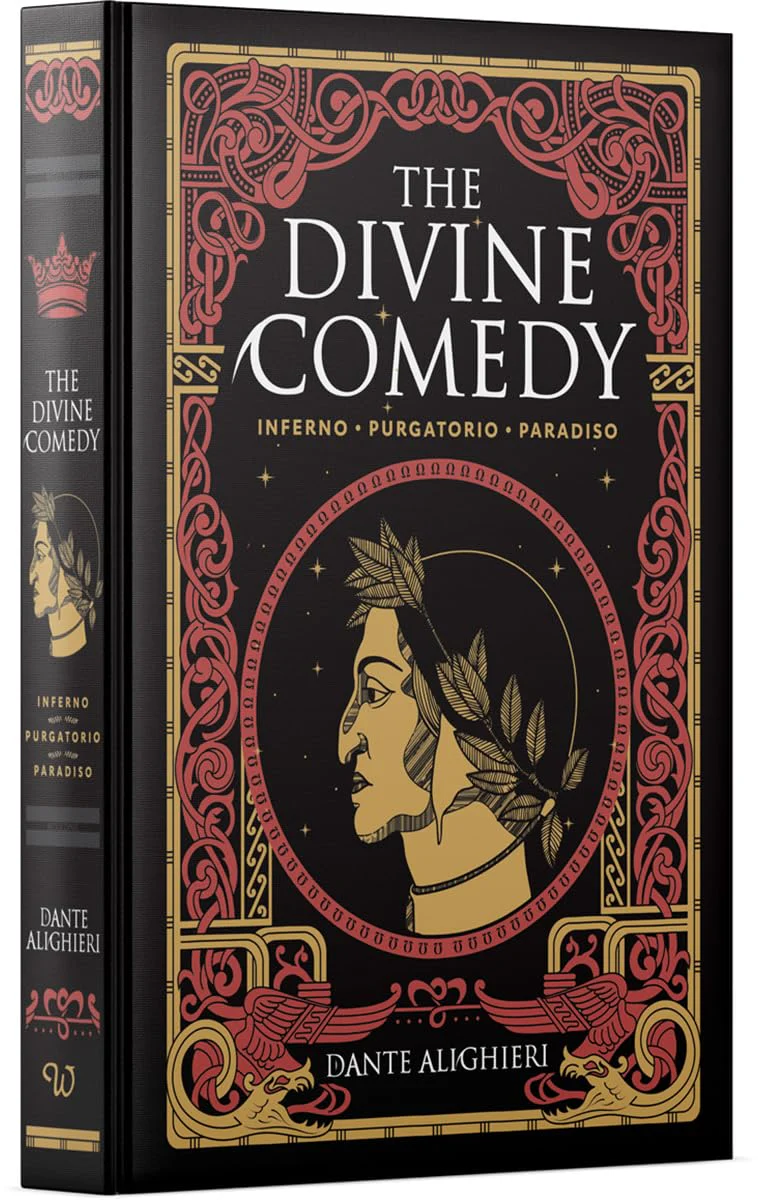
The Divine Comedy chronicles Dante’s journey through Hell, Purgatory, and Heaven.
The poem explores the condition of the soul after death and illustrates the concept of divine justice, where individuals receive either punishment or reward based on their earthly actions.
Guided by Virgil and later by Beatrice and Saint Bernard, Dante meets various historical and mythical figures, each assigned a specific place in the afterlife according to their deeds on Earth, providing a structured vision of what comes after death.
About the author
Dante Alighieri was born in 1265 in Florence. His family, of minor nobility, was not wealthy nor especially distinguished; his mother died when he was a child, his father before 1283. At about the age of 20 he married Gemma Donati, by whom he had three children.
Little is known of Dante's formal education-it is likely to have included study with the Dominicans, the Augustinians, and the Franciscans in Florence, and at the university in Bologna. In 1295 he entered Florentine politics and in the summer of 1300 he became one of the six governing Priors of Florence.
In 1301, the political situation forced Dante and his party into exile. For the rest of his life he wandered through Italy, perhaps studied at Paris, while depending for refuge on the generosity of various nobles.
He continued to write and at some point late in life he took asylum in Ravenna where he completed the Divine Commedia and died, much honoured, in 1321.

Details & Craftsmanship
Every detail has been carefully considered to bring you the perfect product.

Details & Craftsmanship
Every detail has been carefully considered to bring you the perfect product.

Details & Craftsmanship
Every detail has been carefully considered to bring you the perfect product.

Details & Craftsmanship
Every detail has been carefully considered to bring you the perfect product.
Description
The Divine Comedy chronicles Dante’s journey through Hell, Purgatory, and Heaven.
The poem explores the condition of the soul after death and illustrates the concept of divine justice, where individuals receive either punishment or reward based on their earthly actions.
Guided by Virgil and later by Beatrice and Saint Bernard, Dante meets various historical and mythical figures, each assigned a specific place in the afterlife according to their deeds on Earth, providing a structured vision of what comes after death.
About the author
Dante Alighieri was born in 1265 in Florence. His family, of minor nobility, was not wealthy nor especially distinguished; his mother died when he was a child, his father before 1283. At about the age of 20 he married Gemma Donati, by whom he had three children.
Little is known of Dante's formal education-it is likely to have included study with the Dominicans, the Augustinians, and the Franciscans in Florence, and at the university in Bologna. In 1295 he entered Florentine politics and in the summer of 1300 he became one of the six governing Priors of Florence.
In 1301, the political situation forced Dante and his party into exile. For the rest of his life he wandered through Italy, perhaps studied at Paris, while depending for refuge on the generosity of various nobles.
He continued to write and at some point late in life he took asylum in Ravenna where he completed the Divine Commedia and died, much honoured, in 1321.